

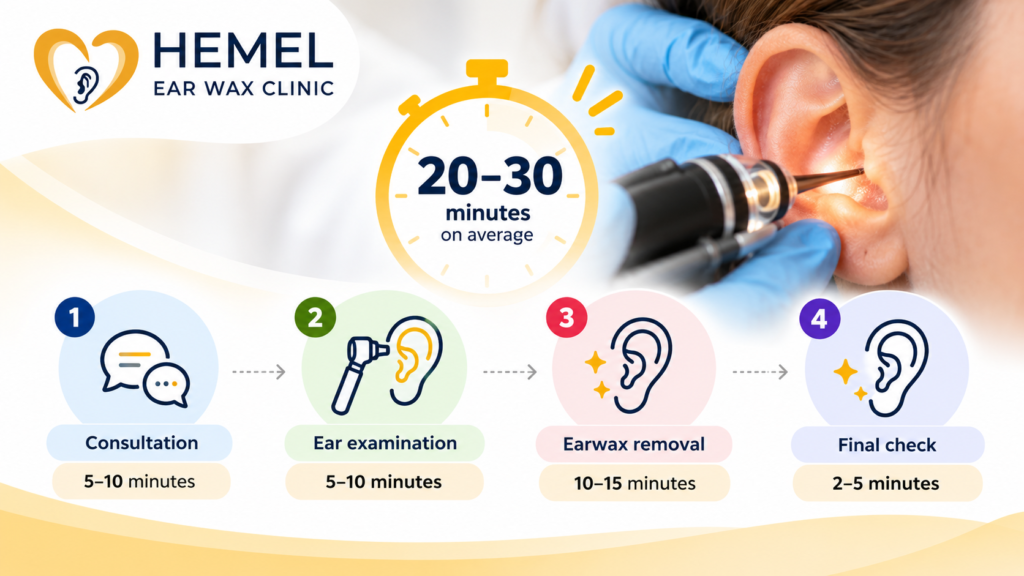
Most professional earwax removal appointments take around 20–30 minutes, although the exact time depends on how much wax is present, whether one or both ears need treatment, and how hard or impacted the wax is.
A blocked ear can affect hearing, cause fullness or create an uncomfortable plugged sensation. Once you decide to have the wax removed, one of the first questions is often: how long does earwax removal take?
For most people, professional microsuction is a relatively quick procedure. However, treatment time can vary depending on the amount and consistency of the wax, the shape of your ear canal and whether one or both ears need attention.
At Hemel Earwax Clinic in Boxmoor, Hemel Hempstead, the complete appointment is usually designed to fit within around 30 minutes and includes an ear assessment before treatment. The clinic currently states that its earwax removal service is generally completed in about 30 minutes.
Key Takeaways
- Most earwax removal visits take around 20–30 minutes.
- Microsuction itself may take only part of that appointment.
- Treating both ears may take longer than treating one.
- Hard or impacted wax can require extra time.
- Softening wax before treatment may make removal easier.
- The clinician should examine your ears before removing wax.
- Some patients need a follow-up appointment if the wax cannot be removed safely in one visit.
How Long Does Earwax Removal Usually Take?
For most patients, an earwax removal appointment takes approximately 20–30 minutes.
This time normally includes more than simply removing the wax. The clinician first needs to discuss your symptoms and relevant ear history. They then examine the ear canal and eardrum before deciding whether microsuction is appropriate.
The wax-removal procedure itself can be relatively quick when the wax is soft and easy to access.
For comparison, University College London Hospitals notes that microsuction itself commonly takes around 15–20 minutes for both ears, although individual treatment times vary.
Therefore, allowing around half an hour for the full visit is a reasonable guide.
Patient Tip: Do not worry if your appointment takes longer than someone else’s. Ear canals and wax build-up vary, so treatment should focus on safe removal rather than speed.
What Happens During the Appointment?
Your appointment starts with an ear assessment before the clinician begins wax removal.
At Hemel Earwax Clinic, the consultation process includes an otoscopic examination to assess the amount of wax and determine the most suitable approach. The clinician also explains the procedure before treatment begins.
A typical visit may involve:
- Reviewing your symptoms and ear history.
- Examining the ear canal with an otoscope.
- Checking whether wax is causing the blockage.
- Performing microsuction where appropriate.
- Rechecking the ear.
- Providing aftercare advice.
This assessment-first approach is important because not every blocked ear is caused by earwax.
What Can Make Earwax Removal Take Longer?
Hard, deep or heavily impacted wax can make treatment take longer.
Some people naturally produce thicker or drier wax. In other cases, cotton buds, hearing aids or earbuds may push wax deeper into the canal.
Treatment may also take longer when:
- Both ears contain significant wax.
- The wax is very hard or dry.
- The ear canal is narrow or curved.
- Wax sits close to the eardrum.
- You have sensitive ears.
- The clinician needs to pause because of discomfort or dizziness.
A careful clinician may stop or slow the procedure when necessary. Safe removal is more important than completing treatment within a fixed number of minutes.
One Ear vs Both Ears: Does Treatment Time Change?
Yes. Treating both ears may take longer, although the difference depends on how much wax is present.
Situation | Approximate Appointment Consideration |
Small amount in one ear | Often relatively quick |
Wax in both ears | May require more treatment time |
Soft, accessible wax | Usually easier to remove |
Hard or impacted wax | May take longer |
Very sensitive ear canal | Clinician may work more slowly |
Wax cannot be removed safely | Follow-up may be needed |
These are general expectations rather than guaranteed timings.
Someone with a small amount of soft wax in both ears may finish more quickly than someone with one ear containing very hard, deeply impacted wax.
Should You Soften Earwax Before Your Appointment?
Softening hard wax beforehand may make removal more comfortable and efficient.
Hemel Earwax Clinic recommends using olive ear spray for around five days before treatment to help soften the wax. However, you should follow the advice given for your own ears, particularly if you have a history of perforated eardrum, ear surgery or other ear conditions.
The NHS also advises that ear-softening drops may help loosen wax, although drops are not suitable for everyone.
If you are unsure whether you should use drops before your appointment, ask the clinic or pharmacist first.
What If the Wax Cannot Be Removed in One Appointment?
Sometimes the safest option is to stop treatment, soften the remaining wax and arrange another attempt.
Very hard wax may not come away easily during the first visit. Trying to remove stubborn wax too aggressively could irritate the ear canal.
Hemel Earwax Clinic states that if the wax is too hard to remove, patients may receive advice to use drops and return for a free follow-up appointment.
This does not mean the treatment has failed. Instead, softening the wax can make the next removal attempt easier and more comfortable.
Remember: A good earwax appointment is not a race. If the wax is difficult to remove, stopping and softening it before another attempt may be safer than forcing the procedure.
Is Microsuction Faster Than Other Earwax Removal Methods?
Microsuction is generally considered a quick method because the clinician removes wax directly under visual guidance.
During microsuction, the practitioner uses a small suction tube while viewing the ear canal. Unlike irrigation, the procedure does not involve flushing water through the ear.
NICE recognises microsuction, electronic irrigation and manual removal as appropriate methods when trained practitioners use them with suitable equipment.
The best method depends on the individual ear rather than speed alone.
Does Microsuction Hurt?
Most people tolerate microsuction well, although sensations vary from person to person.
You may hear suction noise and feel movement or mild pressure inside the ear. Some people with sensitive ears may find certain parts of treatment uncomfortable.
The clinician can pause at any time if you experience discomfort or dizziness.
Because microsuction works under direct visual guidance, the practitioner can see the wax while removing it rather than working blindly.
Afterwards, many patients can return to normal daily activities immediately.
How Quickly Will Your Hearing Improve?
If wax is the main cause of your hearing difficulty, you may notice improvement soon after successful removal.
Some patients notice that sounds seem clearer immediately after the ear canal has been cleared.
However, wax removal will not correct hearing loss caused by another condition.
If your hearing remains reduced after the clinician removes the wax, you may need further assessment.
Sudden hearing loss should never be treated as routine earwax. Seek urgent medical advice if your hearing changes suddenly.
Why Should You Avoid Trying to Speed Up Removal at Home?
Trying to remove wax yourself can push it deeper and make professional treatment more difficult.
Cotton buds are a common example. Instead of pulling wax out, they often push it towards the eardrum.
Avoid inserting:
- Cotton buds
- Ear picks
- Hairpins
- Fingers or other objects
- Ear candles
- Home suction devices
The NHS advises against placing cotton buds or other objects inside the ear because they can push wax further into the canal.
If your ear feels blocked, getting it examined first can save time and reduce the risk of making the blockage worse.
Who May Need Regular Earwax Removal?
Some people develop recurring wax build-up because their ears do not clear wax efficiently.
This is more common in people who have narrow ear canals, naturally hard wax or increased hair within the ear canal.
Hearing-aid and frequent earbud users may also experience recurring blockage because devices inside the ear can interfere with the natural movement of wax.
However, you should not schedule wax removal simply because a certain amount of time has passed. Treatment is generally most useful when wax is causing symptoms or interfering with ear examination or hearing care.
What Are Common Misconceptions About Earwax Removal Time?
“Microsuction always takes exactly 30 minutes.”
No. Thirty minutes is a useful appointment guide, but actual removal time varies considerably.
“Both ears always take twice as long as one ear.”
Not necessarily. The condition and amount of wax matter more than the number of ears alone.
“If the wax is not removed immediately, something has gone wrong.”
No. Hard wax sometimes needs further softening before the clinician can remove it safely.
“Once wax is removed, every hearing problem disappears.”
Not always. Wax removal only helps hearing difficulties caused by earwax blockage.
Why Choose Hemel Earwax Clinic?
Hemel Earwax Clinic provides ear assessment and professional microsuction in Boxmoor, Hemel Hempstead.
The clinic currently offers:
- Otoscopic ear examination
- Medical-grade microsuction
- Personalised ear-care advice
- Follow-up when hard wax cannot be removed initially
- At-home earwax removal for suitable patients
Its at-home service uses video otoscopy and microsuction for people who prefer treatment at home or who find clinic visits difficult.
Hemel Earwax Clinic
49A St John’s Road
Boxmoor
Hemel Hempstead
People Also Ask
How long does microsuction take for one ear?
It depends on the amount and hardness of wax. The actual suction procedure may take only several minutes when wax is easy to access.
How long does it take to clean both ears?
A full microsuction procedure commonly takes around 15–20 minutes for both ears, while the complete appointment may take around 20–30 minutes.
Can earwax be removed in one appointment?
Often yes. However, hard or deeply impacted wax may require softening and a follow-up visit.
Does microsuction work immediately?
The clinician removes wax during the appointment, and people whose hearing loss is caused by wax may notice improvement soon afterwards.
Do I need ear drops before microsuction?
Not always. However, softening hard wax beforehand can sometimes make treatment easier.
Can I go back to work after microsuction?
Most people can resume their normal activities after the procedure.
Frequently Asked Questions
Is 30 minutes enough for earwax removal?
For many people, yes. However, difficult or impacted wax may require more time or a second visit.
Can microsuction remove very hard wax?
It often can, although very hard wax may need softening first.
Is microsuction painful?
Most people tolerate it well, but sensations and sensitivity vary.
Does treating both ears cost more time?
It may take longer, particularly when both ears contain substantial wax.
Why might treatment stop before all the wax is removed?
The clinician may stop if the wax is too hard, difficult to access or uncomfortable to remove safely.
Can I use cotton buds before my appointment?
No. Cotton buds can push wax deeper and make the blockage worse.
How soon will hearing return after removal?
If wax caused the hearing problem, you may notice improvement soon after successful removal.
Where can I book earwax removal in Hemel Hempstead?
Hemel Earwax Clinic in Boxmoor provides professional ear assessment and microsuction.
Conclusion
So, how long does earwax removal take? For most patients, allowing around 20–30 minutes for the complete appointment is a useful guide.
Simple wax build-up may take less time to remove, while hard, deep or impacted wax may require a longer appointment or follow-up treatment.
The important point is that the clinician should first examine your ears and remove the wax carefully rather than rushing the procedure.
If blocked ears, muffled hearing or recurring wax are bothering you, Hemel Earwax Clinic in Boxmoor can assess your ears and provide microsuction when appropriate.
