

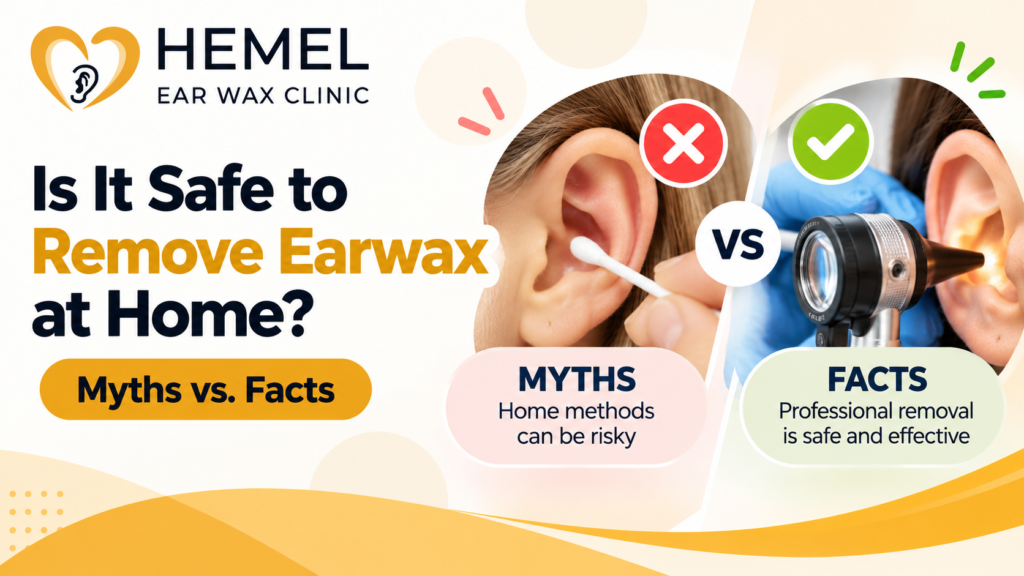
Mild earwax build-up can sometimes be managed safely at home with suitable wax-softening drops, but inserting cotton buds, ear candles, suction gadgets or other objects into the ear can make the problem worse.
A blocked or muffled ear can be frustrating, especially when it feels like something you should be able to fix yourself.
Search online and you will find countless suggestions for removing earwax at home, from cotton buds and ear candles to home irrigation kits and camera-equipped cleaning tools. Unfortunately, not every popular method is safe.
Earwax is not simply dirt. It protects and lubricates the ear canal and usually moves towards the ear opening naturally. Problems arise when too much wax builds up, becomes impacted or causes symptoms such as hearing loss, fullness, itching or tinnitus.
Understanding what you can safely try at home—and what you should avoid—can help protect your ears from unnecessary injury.
At Hemel Earwax Clinic in Boxmoor, Hemel Hempstead, clinicians examine the ear before recommending microsuction or another professional approach where appropriate.
Key Takeaways
- Earwax is normal and helps protect the ear canal.
- Mild wax build-up may sometimes improve with suitable ear-softening drops.
- Cotton buds often push wax deeper instead of removing it.
- Ear candles have not been shown to remove earwax effectively.
- Home suction tools and sharp objects can injure the ear canal.
- Ear drops are not suitable for everyone, particularly with a perforated eardrum.
- Persistent blockage should be professionally assessed.
- Sudden hearing loss should not be assumed to be earwax.
Why Do We Have Earwax?
Earwax is a normal protective substance produced inside the ear canal.
It helps trap dust, dirt and other particles before they travel further into the ear. It also helps lubricate the delicate skin lining the ear canal.
In most people, wax slowly moves towards the outside of the ear through natural skin movement and everyday jaw movements such as talking and chewing.
Therefore, healthy ears usually do not need regular deep cleaning.
Some people naturally produce more wax, while others have narrow ear canals, more ear-canal hair or skin conditions that make troublesome build-up more likely.
Hearing aids, earplugs and frequently worn earbuds can also interfere with the natural movement of wax in some people
Is It Safe to Remove Earwax at Home?
It can be safe to soften uncomplicated earwax at home, but physically digging wax out of the ear canal is not recommended.
For mild wax build-up, the NHS advises that suitable oil-based drops can sometimes help soften wax so that it gradually comes out naturally.
However, there is an important difference between softening wax and attempting to manually remove it yourself.
Trying to scoop, scrape, pull or vacuum wax from inside the ear can push it further down the canal or damage delicate skin.
Ear Care Tip: The safest home approach is usually to help wax leave naturally—not to reach inside the ear and pull it out.
What Can You Safely Try at Home?
For uncomplicated earwax build-up, appropriate wax-softening drops may be enough to improve symptoms.
The NHS suggests olive or almond oil drops as one possible approach for wax build-up, although almond oil should not be used by anyone with an almond allergy.
Wax may gradually soften and work its way out naturally rather than appearing immediately.
However, before using drops, consider whether you have any reason they may be unsuitable. For example, people with a known or suspected perforated eardrum should not simply use ear drops without professional advice.
If you have had previous ear surgery, recurrent infections or another ear condition, it is sensible to ask a healthcare professional before treating the ear yourself.
Which Home Earwax Methods Should You Avoid?
Avoid methods that involve inserting objects, heat or uncontrolled suction into the ear canal.
Common methods that can cause problems include:
- Cotton buds
- Hairpins or ear picks
- Keys or similar objects
- Ear candles
- Home vacuum devices
- Sharp cleaning tools
- Aggressive home syringing
- Camera tools used to scrape wax yourself
The ear canal is narrow and the eardrum is delicate. Without a clear professional view of the ear, it is difficult to know how deep the wax is or what lies behind it.
Why Are Cotton Buds Bad for Earwax?
Cotton buds frequently push wax further into the ear rather than removing it.
A cotton bud may collect a small amount of wax from the entrance of the ear, which can create the impression that it is cleaning effectively.
However, when pushed deeper, it can compress wax further along the canal. Over time, this may contribute to impacted wax and make blockage more difficult to manage.
Cotton buds can also scratch the skin inside the ear or, if inserted too far, injure the eardrum.
You can gently clean the visible outer ear, but there is usually no need to put anything into the ear canal.
Do Ear Candles Remove Earwax?
No reliable evidence shows that ear candles effectively remove earwax.
Ear candles are marketed as a natural method that supposedly creates suction and pulls wax from the ear.
However, the NHS states that there is no evidence that ear candles remove earwax.
Using heat close to the ear can also introduce unnecessary risks, including burns or candle material entering the ear.
If wax is causing symptoms, evidence-based ear care is preferable to ear candling.
Home Earwax Care vs Professional Earwax Removal
Home care is best suited to mild, uncomplicated wax, while professional assessment is more appropriate when symptoms persist or the cause is uncertain.
Home Earwax Care | Professional Earwax Removal |
Suitable for some mild wax build-up | Suitable when wax causes persistent symptoms |
Usually involves wax-softening drops | Begins with an ear examination |
Does not provide a view inside the ear | Clinician can see the ear canal |
May take several days to work | Wax may be removed during the appointment |
Not suitable for every ear condition | Method chosen after assessment |
Should not involve inserting objects | Uses appropriate professional equipment |
The important difference is assessment. A clinician can confirm whether wax is actually responsible for the symptoms before attempting removal.
Are Ear Drops Safe for Everyone?
No. Ear drops can be useful, but they are not appropriate for every person or every ear problem.
The NHS advises against using drops if you have a perforated eardrum.
You should also seek advice before self-treating if you have previously had ear surgery, significant ear pain, discharge, bleeding or symptoms suggesting infection.
Drops may also temporarily make the ear feel more blocked as the wax softens and expands.
If symptoms continue despite several days of appropriate treatment, professional assessment can help determine whether impacted wax or another ear condition is responsible.
When Should You Stop Trying Home Treatment?
Stop relying on home earwax treatment when symptoms are severe, persistent, unusual or getting worse.
Professional or medical advice is particularly important if you experience:
- Sudden hearing loss
- Hearing that deteriorates quickly
- Severe ear pain
- Discharge from the ear
- Bleeding
- Significant dizziness
- Fever with ear symptoms
- Symptoms following an ear injury
Sudden hearing loss should never automatically be treated as ordinary wax.
The NHS advises urgent assessment for sudden hearing loss or rapidly worsening hearing because some causes require prompt treatment.
Why Can Professional Assessment Be Safer?
A professional ear examination reduces guesswork by showing whether wax is present and whether removal is appropriate.
At Hemel Earwax Clinic, the consultation begins with an otoscopic examination. The clinician assesses the level and position of wax before recommending treatment.
Where suitable, microsuction uses controlled suction to remove wax while the clinician views the ear canal.
This allows treatment to be adapted to the individual ear rather than relying on trial-and-error home methods.
The clinic recommends olive ear spray before some appointments to help soften wax and make removal more comfortable and efficient.
Remember: A blocked feeling does not prove that wax is the cause. Looking inside the ear first can prevent unnecessary treatment.
What Happens During Professional Microsuction?
Microsuction removes earwax using a small suction device while the clinician views the ear canal.
A typical appointment at Hemel Earwax Clinic begins with an assessment. The clinician examines the ear, explains the procedure and confirms whether microsuction is suitable.
If treatment proceeds, wax is carefully removed using suction. The clinician can pause or adjust treatment if the ear is sensitive or the wax proves difficult to remove.
Afterwards, patients receive ear-care advice to help reduce future problems.
The clinic also offers an at-home earwax removal service for suitable patients who find attending the clinic difficult.
What Are Common Myths About Removing Earwax at Home?
Myth: “You should regularly clean all wax from your ears.”
Fact: Earwax is protective. Most people do not need to remove it unless it causes symptoms or blocks examination of the ear.
Myth: “Cotton buds are designed to clean inside the ear.”
Fact: Cotton buds can push wax deeper and may damage the ear canal or eardrum.
Myth: “Ear candles suck wax out.”
Fact: There is no good evidence that ear candles effectively remove earwax.
Myth: “If my hearing is muffled, it must be wax.”
Fact: Several ear conditions can cause hearing changes. Sudden or unexplained hearing loss needs assessment.
Myth: “Home suction tools are the same as professional microsuction.”
Fact: Professional microsuction is performed by a trained clinician who can view the ear canal and control the procedure.
How Can You Reduce Future Earwax Build-Up?
The best approach is usually to allow your ears to clean themselves and avoid interfering with the ear canal.
Avoid putting cotton buds, cleaning tools or fingers deep inside your ears.
People who repeatedly develop troublesome wax may benefit from professional advice about occasional softening drops or periodic ear checks.
Hearing-aid users may also need more regular checks because wax can affect both hearing and device performance.
The aim should not be to keep the ear completely free of wax. A small amount of wax is normal and protective.
How Can Hemel Earwax Clinic Help?
Hemel Earwax Clinic provides professional ear assessment and microsuction for people experiencing troublesome wax build-up.
The clinic’s process includes an otoscopic examination, explanation of treatment, microsuction where suitable and personalised aftercare advice.
For suitable patients who cannot easily attend the clinic, a mobile at-home earwax removal service is also available using video otoscopy and microsuction.
Hemel Earwax Clinic
49A St John’s Road
Boxmoor
Hemel Hempstead
If home treatment has not improved your blocked or muffled ears, booking an examination can help confirm whether earwax is actually responsible.
People Also Ask
Is it safe to remove earwax yourself?
It is generally safer to soften uncomplicated wax rather than manually remove it. Avoid inserting cotton buds, tools or suction devices into your ear canal.
What is the safest way to remove earwax at home?
For suitable people, wax-softening drops may help wax leave naturally. Ask a pharmacist or healthcare professional if you are unsure which product is appropriate.
Can olive oil remove earwax?
Olive oil can soften wax and help it move out naturally, although it does not instantly extract the wax.
Are cotton buds safe for earwax?
No. Cotton buds may push wax deeper and can damage the ear canal or eardrum.
Do ear candles work?
There is no evidence that ear candles effectively remove earwax.
When should I see someone about blocked ears?
Seek professional assessment if symptoms persist, hearing is significantly affected or you develop pain, discharge, bleeding or dizziness.
Conclusion
So, is it safe to remove earwax at home? The answer depends on what you mean by removal.
For uncomplicated wax build-up, suitable ear-softening drops may help the ear clear itself naturally. However, cotton buds, ear candles, home suction devices and other objects should not be inserted into the ear canal.
If blockage continues, hearing remains muffled or you are unsure whether wax is really the cause, professional assessment is the safer next step.
Sudden hearing loss, severe pain, discharge, bleeding or significant dizziness should receive medical attention rather than routine home wax treatment.
For professional ear assessment and microsuction in Hemel Hempstead, contact Hemel Earwax Clinic in Boxmoor.
Frequently Asked Questions
Does earwax need to be removed regularly?
No. Earwax is normal and usually only needs treatment when it causes symptoms or interferes with ear examination.
Can home earwax removal damage the eardrum?
Inserting tools or cotton buds too deeply can potentially injure the ear canal or eardrum.
Can I use ear drops if I have a perforated eardrum?
Do not use ear drops without professional advice if you have a known or suspected perforated eardrum.
How long do earwax drops take to work?
Wax-softening drops may take several days, and softened wax may continue to come out naturally afterwards.
Why does my ear feel more blocked after using drops?
Softening wax can temporarily change its consistency or volume, making the blocked sensation more noticeable.
Is microsuction better than cotton buds?
Microsuction is a professional procedure performed under visual guidance. Cotton buds can push wax deeper and are not recommended for cleaning inside the ear canal.
Is professional earwax removal painful?
Most people tolerate microsuction well, although suction noise, mild pressure or temporary sensitivity can occur.
Where can I get earwax removal in Hemel Hempstead?
Hemel Earwax Clinic in Boxmoor provides ear assessment, microsuction and an at-home service for suitable patients.
