

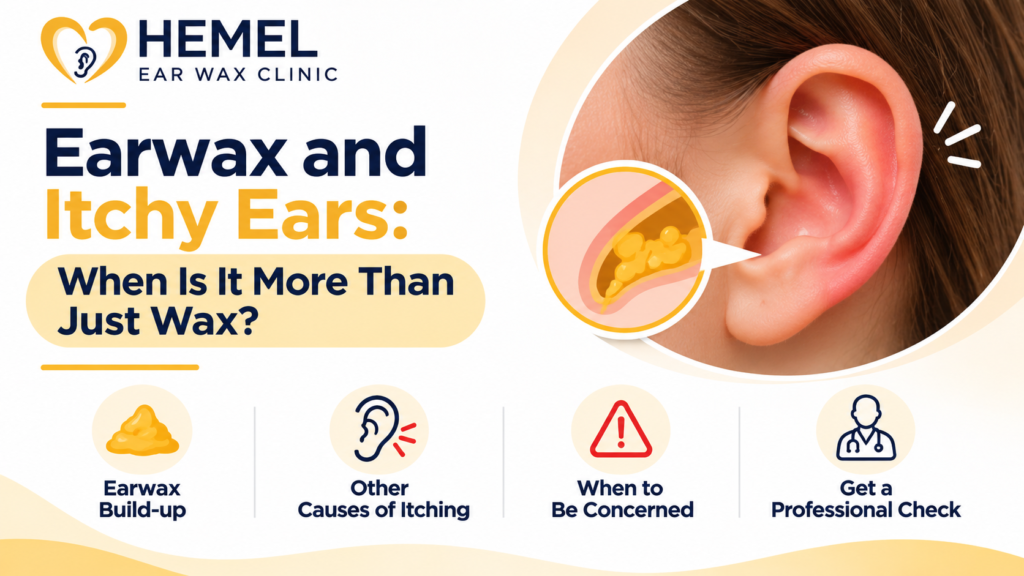
An itchy ear can be caused by earwax, but persistent itching may point to dry skin, eczema, irritation or an outer-ear infection instead.
An occasional ear itch is common and often harmless. The problem starts when itching keeps returning, becomes uncomfortable or is accompanied by blocked hearing, soreness or discharge.
Many people assume the cause must be earwax. While earwax and itchy ears can certainly be connected, wax is only one possible explanation.
The skin inside the ear canal is delicate. Dryness, eczema, scratching, water, earplugs and infections can all cause similar symptoms.
Hemel Earwax Clinic in Boxmoor provides otoscopic ear assessment and microsuction where wax is present and removal is appropriate.
Key Takeaways
- Earwax can cause itching when it builds up or becomes impacted.
- Normal earwax is protective and does not need routine removal.
- Persistent itching may be caused by dry skin or eczema.
- Otitis externa can cause itching, pain, swelling and discharge.
- Cotton buds can make both itching and wax blockage worse.
- Earbuds and earplugs may irritate the ear canal.
- Wax removal will not solve itching caused by another condition.
- Recurrent symptoms should be examined rather than repeatedly self-treated.
Can Earwax Make Your Ears Itch?
Yes. Earwax can cause itching when it becomes excessive, dry or impacted.
Earwax, medically called cerumen, normally protects the ear canal from dust, dirt and germs. It also helps keep the canal from becoming too dry.
Problems can develop when wax builds up faster than it can leave naturally.
NICE lists itching among the possible symptoms associated with impacted earwax.
Is Some Earwax Good for Your Ears?
Yes. Healthy earwax has an important protective role.
The ear canal normally cleans itself through natural skin movement and movements of the jaw.
A small amount of wax should therefore remain inside the ear. Trying to remove every trace of wax can irritate the skin and may actually make itching worse.
The aim of earwax treatment is to remove troublesome or impacted wax, not to make the ear canal completely wax-free.
How Do You Know If Earwax Is Causing the Itch?
Wax is more likely when itching occurs with a blocked sensation, muffled hearing or visible wax.
Other possible symptoms include fullness, tinnitus or mild discomfort.
However, symptoms alone cannot confirm the diagnosis.
An otoscopic examination allows a clinician to see whether wax is actually blocking or irritating the ear canal.
If your ear keeps itching, avoid trying to diagnose the problem with a cotton bud. Looking inside the ear properly is much more useful than repeatedly cleaning it.
When Might Itching Be More Than Earwax?
Persistent itching is more likely to need further assessment when other symptoms are present.
Signs that another problem may be involved include:
- Ear pain
- Discharge
- Swelling
- Flaky or cracked skin
- Increasing redness
- Reduced hearing
- Recurrent symptoms after wax removal
These symptoms can occur with ear-canal inflammation or infection.
Could Dry Skin Cause Itchy Ears?
Yes. Dry skin inside or around the ear can cause persistent itching even when little wax is present.
The ear canal contains sensitive skin, just like other parts of the body.
Over-cleaning can remove natural oils and protective wax, leaving the skin dry and irritated.
People may then enter a cycle of itching, scratching and further irritation.
NHS ear-care guidance advises avoiding unnecessary cleaning inside the ear canal.
Can Eczema Affect the Ear Canal?
Yes. Eczema can affect the skin around the ear and inside the ear canal.
It may cause dryness, itching, redness and flaky skin.
The NHS recognises skin conditions such as eczema as a factor that can contribute to outer-ear inflammation and earwax problems.
If itching repeatedly returns despite wax removal, the underlying skin condition may need treatment rather than more ear cleaning.
What Is Otitis Externa?
Otitis externa is inflammation or infection of the outer ear canal and commonly causes itching.
It is sometimes called swimmer’s ear.
Possible causes include bacteria, fungi, eczema, water entering the ear or damage caused by scratching and cotton buds.
Symptoms may include itching, discomfort, discharge, swelling and reduced hearing.
When infection or inflammation is present, treatment is different from simple earwax removal.
Earwax Itching vs Otitis Externa
Earwax and otitis externa can cause similar symptoms, but the treatment is different.
Earwax Build-Up | Otitis Externa |
Wax visible in the canal | Canal may look red or swollen |
Can cause itching | Itching can be prominent |
Often causes blocked hearing | Hearing may reduce if canal swells |
Usually little or no discharge | Discharge may occur |
Removal may relieve symptoms | Usually needs treatment for inflammation or infection |
Often painless | Pain or tenderness may develop |
This is why an examination is important before assuming that itching requires microsuction.
Can Water Make Your Ears Itchy?
Yes. Water can irritate the ear canal and contribute to otitis externa.
Swimming, frequent showers or water trapped behind earwax can create a moist environment.
This can encourage inflammation or infection.
People who repeatedly develop itchy ears after swimming may need advice about keeping their ears dry rather than simply removing wax each time.
Can Earbuds and Earplugs Cause Itching?
Yes. Devices placed inside the ear can irritate sensitive skin and interfere with natural wax clearance.
Earbuds, headphones, hearing aids and earplugs may trap moisture or rub against the ear canal.
They can also push existing wax deeper.
If itching is worse after using a particular device, reduce use temporarily and have the ear checked if symptoms persist.
Can Hearing Aids Contribute to Itchy Ears?
Yes. Hearing aids can sometimes contribute to wax build-up and skin irritation.
Devices sitting inside the ear may interfere with the natural movement of wax.
Moisture and friction can also irritate the ear-canal skin.
Hearing-aid users with recurring itching or feedback should have both the device and ear canal checked.
Why Do Cotton Buds Make Itchy Ears Worse?
Cotton buds can scratch the ear canal and push wax deeper.
The temporary relief from scratching can encourage people to keep using them.
However, repeated contact damages the delicate skin and may increase inflammation or infection risk.
The NHS advises against putting cotton buds, fingers or other objects into the ear canal.
Only the outside of the ear normally needs cleaning.
Should You Scratch Inside an Itchy Ear?
No. Scratching inside the ear can damage the skin and worsen the problem.
Fingernails, hairpins and other objects can create tiny cuts.
Once the protective skin barrier is damaged, bacteria or fungi can more easily cause inflammation or infection.
If itching is severe enough that you constantly want to scratch the ear, arrange an assessment instead
Should You Use Ear Drops for Itching?
Not every itchy ear should be treated with ear drops.
Wax-softening drops may be useful when troublesome earwax is present, but they will not treat every cause of itching.
Some preparations may irritate already sensitive ear-canal skin.
Drops are also not appropriate for everyone, particularly people with a known or suspected perforated eardrum unless advised by a healthcare professional.
The correct treatment depends on what is actually causing the itch.
Can Olive Oil Help With Earwax?
Hemel Earwax Clinic currently advises suitable patients to use olive ear spray for around five days before microsuction.
This can make dry or impacted wax easier to remove.
However, olive oil should not automatically be used as a treatment for unexplained itching.
If there is pain, discharge or suspected infection, the ear should be assessed first.
When Does Itchy Earwax Need Removal?
Wax removal may be appropriate when impacted earwax is causing symptoms or preventing the ear from being examined.
NICE recommends removal when wax contributes to hearing loss or other symptoms.
Microsuction is one professional option.
At Hemel Earwax Clinic, the ear is examined before treatment begins to confirm whether wax is actually present and whether microsuction is appropriate.
How Does Microsuction Help?
Microsuction can remove troublesome wax and debris using controlled suction while the practitioner views the ear canal.
It does not require water to be flushed into the ear.
Removing impacted wax may relieve itching when wax itself is responsible.
However, if the itching comes from eczema, infection or another skin problem, removing wax alone may not solve it.
Recurrent itching after successful wax removal is a clue that wax may not be the only cause. Another ear-canal or skin condition may need assessment.
What If Itching Continues After Wax Removal?
Persistent itching after the ear has been cleared should be reassessed.
If no significant wax remains, repeatedly booking wax removal is unlikely to address the underlying problem.
A healthcare professional may need to consider dry skin, dermatitis, eczema or otitis externa.
Hemel Earwax Clinic can examine the ear and advise when further GP or specialist assessment may be more appropriate.
What Are Common Mistakes With Itchy Ears?
The biggest mistake is treating every itch as excess earwax.
Another common problem is repeatedly cleaning the ear canal, which can remove protective wax and irritate the skin.
People may also use several different drops without knowing whether infection, eczema or a perforated eardrum is present.
Assessment is safer when symptoms are persistent or recurring.
Common Misconceptions
Itching always means there is too much wax
No. Dry skin, eczema and otitis externa can also cause itching.
Earwax is dirty and should all be removed
No. Earwax has an important protective function.
Cotton buds are safe if used gently
No. They can push wax deeper and damage sensitive ear-canal skin.
Microsuction cures every itchy ear
No. It can help if wax is the cause, but it does not treat every skin condition or infection.
More itching means more wax is being produced
Not necessarily. The ear may be irritated even when very little wax is present.
When Should You Seek Medical Advice?
Pain, discharge or persistent swelling should be medically assessed rather than treated as ordinary wax.
Seek advice if itching is accompanied by worsening pain, fluid or pus from the ear, significant swelling, fever or persistent hearing loss.
People with diabetes or significant immune suppression should also seek prompt medical advice for suspected outer-ear infection.
Sudden hearing loss should be treated urgently and should not be assumed to be caused by wax.
How Can Hemel Earwax Clinic Help?
Hemel Earwax Clinic can examine itchy or blocked ears to determine whether earwax is contributing to the problem.
The appointment begins with a patient-history review and otoscopic examination.
Where impacted wax is present and microsuction is appropriate, medical-grade microsuction can be used to remove it.
If the findings suggest another problem rather than simple wax build-up, appropriate further care can be recommended.
Hemel Earwax Clinic
49A St John’s Road
Boxmoor
Hemel Hempstead
HP1 1QQ
The clinic also offers at-home earwax removal for suitable patients.
People Also Ask
Can earwax make your ear itchy?
Yes. Impacted or excessive wax can irritate the ear canal and cause itching.
Why are my ears itchy but there is no wax?
Dry skin, eczema, dermatitis or outer-ear inflammation may be responsible.
Can an ear infection start with itching?
Yes. Otitis externa often causes itching and may later cause pain, discharge or swelling.
Should I use cotton buds for itchy ears?
No. Cotton buds can irritate the skin and push wax deeper.
Can microsuction stop itchy ears?
It may help when impacted wax is causing the itching, but it will not treat every cause.
Why does my ear still itch after wax removal?
Another problem such as dry skin, eczema or otitis externa may be present.
Frequently Asked Questions
Is itchy earwax normal?
Occasional mild itching can occur, but persistent or uncomfortable itching deserves assessment.
Can eczema occur inside the ear?
Yes. Eczema can affect the ear canal and surrounding skin.
Can swimming make ears itchy?
Yes. Water can irritate the canal and contribute to otitis externa.
Can earbuds cause itchy ears?
Yes. Friction, moisture and wax compaction can all contribute.
Should all visible earwax be removed?
No. Normal earwax protects the ear and usually does not require treatment.
Can I use olive oil for itchy ears?
Only when it is appropriate for wax softening. Unexplained itching should be assessed first.
When should I worry about an itchy ear?
Seek advice when itching comes with pain, discharge, swelling, persistent hearing loss or recurring symptoms.
Where can I get itchy ears checked in Hemel Hempstead?
Hemel Earwax Clinic provides otoscopic examination and microsuction where appropriate at 49A St John’s Road in Boxmoor.
Conclusion
Earwax and itchy ears can be related, but wax is not always the cause.
Persistent itching may come from dry skin, eczema, irritation or otitis externa. If symptoms keep returning, an ear examination can identify whether wax removal or another type of care is needed.
