

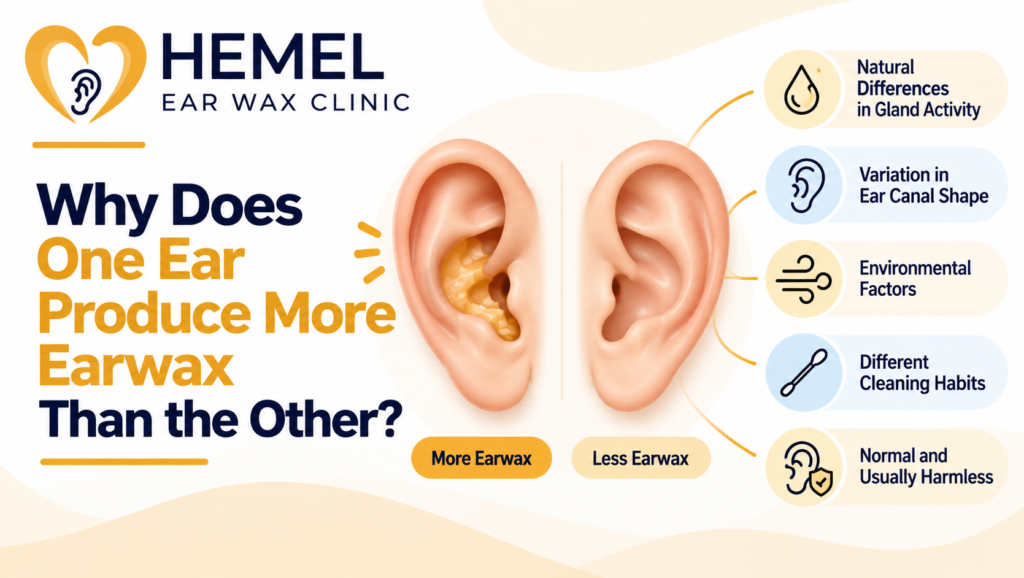
It is common for one ear to seem waxier than the other, and the difference often relates to how well each ear clears wax rather than simply producing more.
If one ear repeatedly becomes blocked while the other stays clear, it is reasonable to wonder why.
The difference does not always mean one ear is actually producing much more wax. Often, one ear has more earwax because it is not clearing wax as efficiently.
Ear canal shape, skin condition, hearing aids and cleaning habits can all affect how wax moves naturally towards the ear opening.
Hemel Earwax Clinic in Boxmoor provides otoscopic ear assessment and microsuction where wax removal is appropriate.
Key Takeaways
- It is possible for one ear to collect more wax than the other.
- Ear canal shape can affect natural wax movement.
- A narrow or curved canal may trap wax more easily.
- Hearing aids, earbuds and earplugs can interfere with wax clearance.
- Cotton buds often push wax deeper.
- Skin conditions may contribute to recurring blockage.
- One-sided hearing loss should not automatically be assumed to be wax.
- An ear examination can confirm whether wax is actually present.
Is It Normal for One Ear to Have More Earwax?
Yes. The amount and appearance of earwax can differ between the two ears.
Earwax, or cerumen, is naturally produced in the outer part of the ear canal. It helps protect the skin, trap dust and reduce the entry of dirt and other particles.
The ears normally move wax towards the opening through natural skin movement and jaw activity. If this process works less effectively on one side, wax may accumulate there even if production itself is similar.
Does One Ear Actually Produce More Wax?
It may, but apparent differences are often caused by wax retention rather than increased production.
It is difficult to judge wax production simply by looking at how much wax is visible. One ear may clear wax efficiently while the other retains it.
The retained ear can therefore appear to be the “waxier” ear.
For recurring one-sided problems, the more useful question is often why that ear is not clearing wax normally.
Can Ear Canal Shape Cause More Wax on One Side?
Yes. Differences in ear canal anatomy can make one side more prone to wax build-up.
The NHS identifies narrow or damaged ear canals as recognised reasons for excessive earwax accumulation.
One canal may be narrower, more curved or contain more hair than the other. These differences can slow the natural outward movement of wax.
This helps explain why someone may repeatedly need treatment in only one ear.
Can Ear Hair Affect Earwax Build-Up?
Yes. Increased hair inside the ear canal can interfere with natural wax clearance.
Hair may act as a physical barrier and make it harder for wax to move towards the outer ear.
The amount of ear-canal hair can also differ between the two sides.
This becomes more common with age, which is one reason some older adults experience recurrent earwax problems.
Can Hearing Aids Cause More Wax in One Ear?
Hearing aids can contribute to wax build-up by interfering with its natural movement out of the ear canal.
A device sitting inside the ear may push wax inward or prevent it from leaving normally.
Someone who wears a hearing aid in only one ear may therefore notice more frequent blockage on that side.
Wax can also affect hearing-aid performance by blocking sound or causing whistling.
Patient Tip: If the same hearing-aid ear repeatedly blocks, an occasional professional ear check may be more useful than trying to clean the canal yourself.
Do Earbuds and Earplugs Affect Wax?
Yes. Anything regularly inserted into the ear canal can interfere with natural wax clearance.
Frequent use of in-ear headphones, earbuds or earplugs may compact wax or prevent it from naturally migrating out.
If you use one earbud more often than the other, the difference may be especially noticeable.
NICE also notes that earbud-type devices and hearing aids are associated with earwax problems.
Can Cotton Buds Cause One-Sided Blockage?
Yes. Cotton buds commonly push wax deeper instead of removing it.
If you clean one ear more aggressively or more often, wax may become compacted on that side.
A cotton bud can also irritate the ear-canal skin or push wax closer to the eardrum.
NICE advises against inserting cotton buds or other small objects into the ear canal.
Can Skin Conditions Affect One Ear More Than the Other?
Yes. Skin conditions affecting the ear canal can contribute to wax and debris build-up.
Conditions such as eczema or inflammation of the outer ear may change the skin inside the canal.
The NHS identifies skin conditions and otitis externa as factors associated with earwax build-up.
If one ear is itchy, sore or flaky as well as repeatedly waxy, it may need assessment rather than repeated wax removal alone.
More Earwax vs Poorer Earwax Clearance
The difference is important because visible wax does not tell you how much each ear actually produces.
More Wax Production | Poorer Wax Clearance |
More cerumen may naturally be produced | Wax does not move out efficiently |
Can vary between individuals | Often linked with canal shape |
May affect both ears | Can mainly affect one ear |
Wax may remain soft | Wax may become compacted |
Not always problematic | More likely to cause blockage |
In practice, both factors can occur together.
An otoscopic examination can show where wax is sitting and whether it is actually obstructing the canal.
Why Does the Same Ear Keep Getting Blocked?
Repeated blockage in one ear often suggests a local factor affecting that side.
A narrow canal, more hair, hearing-aid use, previous ear surgery or repeated cotton-bud use can all contribute.
Sometimes the wax itself is naturally harder or drier, making it more difficult to leave the canal.
Recurring symptoms deserve examination, especially if the blockage returns quickly after successful removal.
Can Sleeping on One Side Cause More Earwax?
There is no strong evidence that simply sleeping on one side causes excessive earwax production.
People sometimes notice a connection between their sleeping position and ear symptoms, but earwax accumulation is more strongly associated with factors such as canal anatomy, age, devices in the ear and cleaning habits.
If one ear repeatedly feels blocked in the morning, wax is only one possible explanation.
Pressure changes, congestion or another ear condition may produce a similar sensation.
Does Age Affect Earwax?
Yes. Earwax often becomes harder and drier with age.
Harder wax may not move out as easily as softer wax.
If one ear canal is already narrower or more curved, age-related changes can make the difference between the two ears more noticeable.
This does not mean earwax should routinely be removed simply because someone is older.
Treatment is generally needed when wax causes symptoms or prevents proper examination.
What Symptoms Suggest One-Sided Earwax Blockage?
A one-sided blockage may cause fullness, reduced hearing, itching or tinnitus in the affected ear.
Typical symptoms can include:
- Muffled hearing
- A blocked or full sensation
- Ear discomfort
- Itching
- Tinnitus
- Occasionally dizziness
Symptoms alone cannot confirm earwax.
Ear infections, pressure problems and other hearing conditions can produce similar complaints.
Can One-Sided Earwax Cause Hearing Loss?
Yes. Impacted wax can temporarily reduce hearing in the affected ear.
Wax physically blocks sound from travelling through the ear canal effectively.
Hearing often improves after the obstruction is removed.
However, persistent one-sided hearing loss after wax removal should be medically assessed.
Do not assume every change in hearing is caused by wax.
Should You Remove More Wax From the Waxier Ear at Home?
No. Avoid trying to dig or scrape wax from the ear canal.
Suitable ear-softening drops may help uncomplicated wax, but they are not appropriate for everyone.
Do not use drops if you have a known perforated eardrum unless advised by a healthcare professional.
If one ear repeatedly blocks, professional examination can identify whether wax is genuinely the problem.
When Is Professional Earwax Removal Appropriate?
Professional removal is appropriate when wax is causing symptoms or preventing examination of the ear.
NICE recommends removing earwax when it contributes to hearing loss or other symptoms.
Microsuction, electronic irrigation and suitable manual removal are recognised methods when performed by trained professionals with appropriate equipment.
At Hemel Earwax Clinic, the ears are examined before microsuction is performed.
How Does Microsuction Work?
Microsuction removes wax using controlled suction while the practitioner views the ear canal.
The clinician first checks the ear canal and eardrum with an otoscope.
If wax is present and microsuction is suitable, a small suction device is used to remove it carefully.
The process does not normally involve flushing water into the ear.
Hemel Earwax Clinic states that appointments usually take around 30 minutes, although actual removal time varies.
Should You Soften the Wax First?
Softening can make hard or dry wax easier to remove.
Hemel Earwax Clinic recommends suitable patients use olive ear spray for around five days before treatment.
If wax remains too hard to remove safely, the clinic may advise further softening and a free follow-up.
Not everyone should use ear drops, so people with previous ear surgery, perforation or discharge should seek advice first.
Remember: The aim is not to make both ears completely free of wax. Healthy earwax is protective; treatment is mainly needed when wax becomes impacted or symptomatic.
What If Only One Ear Needs Treatment?
There is no requirement to remove wax from both ears if only one is causing a problem.
The practitioner can examine both ears and determine whether treatment is needed on either side.
Normal wax in an asymptomatic ear can often be left alone.
Removing wax unnecessarily may disturb the natural protective function of the ear canal.
Common Misconceptions
Both ears should produce exactly the same amount of wax
No. Ear anatomy and clearance can differ between the two sides.
More visible wax means the ear is unhealthy
Not necessarily. Earwax is normal and protective.
One blocked ear always means earwax
No. Infection, Eustachian tube problems and hearing conditions can cause similar symptoms.
Cleaning the waxier ear more often prevents blockage
Not with cotton buds. Repeated cleaning can push wax deeper.
Both ears should always be cleaned during microsuction
No. Treatment should be based on examination and symptoms.
When Should You Seek Medical Advice?
Persistent one-sided symptoms should not automatically be treated as recurring wax.
Seek appropriate medical advice if hearing remains reduced after successful wax removal.
Pain, persistent discharge, bleeding or recurrent vertigo also require assessment.
Sudden hearing loss should be treated urgently rather than waiting for a routine earwax appointment.
How Can Hemel Earwax Clinic Help?
Hemel Earwax Clinic can check why one ear repeatedly develops wax or blocked-ear symptoms.
The clinic provides patient-history review, otoscopic examination and medical-grade microsuction where suitable.
If wax is too hard to remove safely, further softening and a free follow-up may be advised.
Hemel Earwax Clinic
49A St John’s Road
Boxmoor
Hemel Hempstead
HP1 1QQ
At-home earwax removal is also available for suitable patients.
People Also Ask
Why does one ear get more wax than the other?
Differences in ear-canal shape, hair, hearing-aid use and natural wax clearance can cause one ear to accumulate more wax.
Is it normal to have more earwax in one ear?
Yes. The amount of retained wax can differ between ears.
Can a narrow ear canal cause wax build-up?
Yes. Narrow canals can make natural wax clearance more difficult.
Can earbuds make one ear waxier?
Frequent earbud use can interfere with wax movement, particularly if one earbud is used more often.
Should both ears be cleaned if only one is blocked?
Not necessarily. Normal wax does not need to be removed unless it causes symptoms or prevents examination.
Why does the same ear keep blocking?
A local factor such as canal shape, hair, hearing-aid use or recurrent inflammation may be contributing.
Frequently Asked Questions
Is one-sided earwax dangerous?
Usually not, but persistent symptoms should be examined to confirm wax is the cause.
Can one ear naturally be narrower?
Yes. Ear-canal anatomy can differ between sides.
Do hearing aids increase wax build-up?
They can interfere with natural wax clearance.
Can cotton buds cause one-sided wax blockage?
Yes. They can push wax deeper and create impaction.
Should I use olive oil in only the blocked ear?
Follow individual advice. Ear drops are not suitable for everyone.
Can earwax affect hearing in just one ear?
Yes. Impacted wax can cause temporary one-sided hearing loss.
What if hearing stays poor after wax removal?
Seek further medical or audiological assessment.
Where can I get my ears checked in Hemel Hempstead?
Hemel Earwax Clinic provides ear examination and microsuction at 49A St John’s Road in Boxmoor.
Conclusion
One ear may appear to produce more wax because it clears wax less effectively than the other.
Ear canal shape, hearing aids, earbuds, hair and cleaning habits can all contribute. If the same ear repeatedly becomes blocked, an examination can confirm whether wax or another problem is responsible.
