

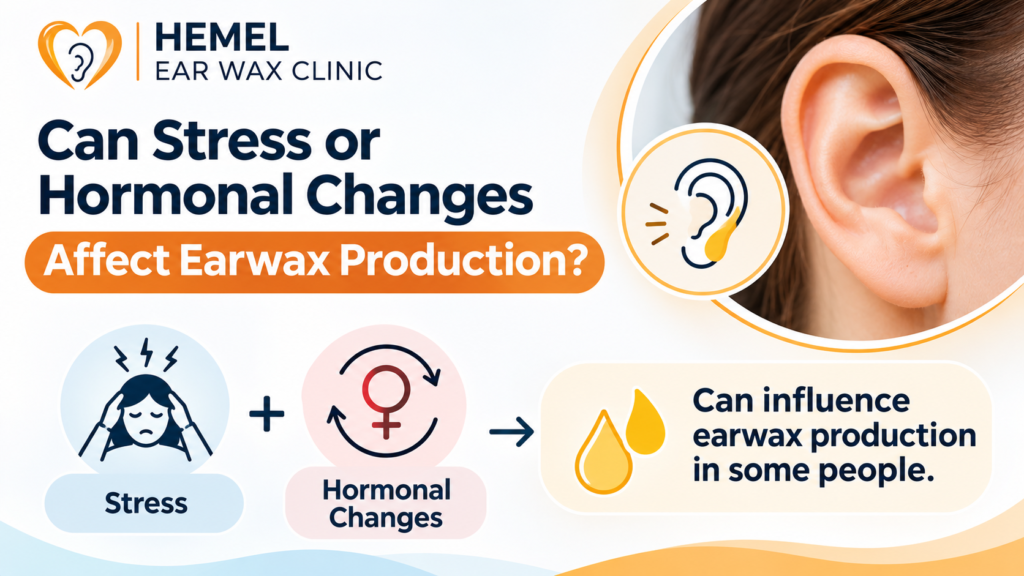
Stress may be associated with increased earwax in some people, while the evidence that normal hormonal changes directly increase earwax production is much less certain.
Noticing more earwax during a stressful period, pregnancy, menopause or another hormonal change can make you wonder whether the two are connected.
There may be some relationship between stress and earwax production, but it is important not to overstate it. Stress has been linked with increased wax in NHS ear-care information, while direct evidence for hormonal changes affecting earwax production remains limited.
If wax repeatedly causes blocked ears, muffled hearing or discomfort, Hemel Earwax Clinic can examine the ear canal to determine whether excess or impacted wax is actually present.
Key Takeaways
- Earwax is a normal protective substance.
- Some NHS guidance lists stress and anxiety as possible contributors to excess wax.
- Earwax is partly produced by modified apocrine glands.
- Direct evidence linking periods, pregnancy or menopause to excess earwax is limited.
- Earwax build-up is not the same as increased earwax production.
- Ear canal shape, ageing and hearing aids are established contributors to blockage.
- Cotton buds can make wax impaction worse.
- Recurring symptoms are best assessed with an ear examination.
What Is Earwax and Why Is It Produced?
Earwax, or cerumen, is a natural substance that protects and lubricates the ear canal.
It is made from secretions from ceruminous and sebaceous glands together with dead skin cells and other material.
Ceruminous glands are specialised modified apocrine glands located in the outer ear canal.
Normally, earwax gradually moves towards the opening of the ear and falls away naturally.
Can Stress Affect Earwax Production?
Possibly. Some NHS ear-care guidance identifies anxiety and stress as factors associated with excessive earwax.
Cambridge University Hospitals states that wax build-up may occur with anxiety, stress, dietary or hereditary factors.
Other NHS ear-care information also mentions stress as a possible contributor to increased wax production.
However, this does not mean every stressful period will cause excessive earwax.
Individual responses vary considerably.
Why Might Stress Affect Earwax?
A possible explanation is that earwax-producing glands are related to apocrine glands, which can respond to emotional stress.
Ceruminous glands are modified apocrine glands.
General apocrine sweat glands can become more active during strong emotions such as anxiety or stress.
This makes a relationship biologically plausible.
However, research specifically proving that psychological stress directly causes clinically significant excess earwax is limited.
“Stress may be one factor affecting earwax, but recurring blockage should still be confirmed by examining the ear rather than assuming stress is the cause.”
Does Cortisol Increase Earwax?
There is not enough evidence to say that higher cortisol directly causes excessive earwax production.
Cortisol is an important stress hormone, and researchers have even investigated earwax as a way of measuring long-term cortisol levels.
Interestingly, research into earwax cortisol suggested that the earwax sample itself may be relatively resistant to short-term systemic stress effects.
That research was designed to measure cortisol rather than determine how much earwax stress produces.
It therefore does not prove that cortisol causes wax blockage.
Can Hormonal Changes Affect Earwax Production?
Hormones may influence skin and gland behaviour, but direct evidence linking normal hormonal changes to excessive earwax is weak.
Ceruminous glands are related to apocrine glands, while sebaceous glands also contribute to earwax.
Both gland types can be influenced by biological development and hormonal processes.
However, this does not mean changes in oestrogen, progesterone or testosterone automatically produce more earwax.
A small study examining cerumen production found that sex was not a significant factor and suggested sex hormones played only a minor role in the lipid component of earwax.
Can Puberty Change Earwax?
Changes in skin and gland activity occur during puberty, but there is no strong clinical evidence that puberty commonly causes problematic excess earwax.
Many apocrine glands become more active around puberty because of hormonal changes.
Ceruminous glands are a specialised form of apocrine gland, although they function differently from ordinary underarm apocrine glands.
If a teenager develops recurring blocked ears, other factors such as earbuds, earplugs or naturally narrow canals may be more relevant.
Can Your Period Affect Earwax?
There is currently little high-quality evidence that the menstrual cycle predictably changes earwax production.
Hormonal levels fluctuate throughout the menstrual cycle and can affect several body systems.
However, menstrual changes are not listed among the main recognised causes of earwax build-up in NHS guidance.
If earwax seems to increase around the same stage of each cycle, the pattern can be observed, but it should not automatically be assumed to be hormonal.
Can Pregnancy Increase Earwax?
Pregnancy causes major hormonal changes, but increased earwax is not an established or routinely recognised pregnancy-related condition.
Some people may personally notice differences in skin or body secretions during pregnancy.
That does not establish pregnancy as the cause of excess cerumen.
If blocked ears occur during pregnancy, an ear examination can determine whether wax, congestion or another problem is responsible.
Can Menopause Change Earwax?
There is not enough evidence to say menopause directly causes increased earwax production.
Menopause can affect skin moisture and other gland-related processes because of changing hormone levels.
However, ageing itself is a recognised factor in earwax problems.
Wax can become harder and drier with age, which may make natural clearance less effective.
This means a blockage occurring around menopause may relate more to changes in wax consistency and ageing than hormones alone.
Earwax Production vs Earwax Build-Up
Producing more earwax and developing an earwax blockage are not the same thing.
Increased Production | Earwax Build-Up |
More wax may be secreted | Wax fails to leave the canal |
Stress may possibly contribute | Canal shape can contribute |
Individual production varies | Hearing aids can trap wax |
Does not always cause symptoms | May cause fullness or hearing loss |
May clear naturally | May become impacted |
Someone can produce a normal amount of wax but still experience repeated blockage because the wax does not move out effectively.
What Causes Earwax to Build Up?
Several well-established factors are more strongly associated with wax blockage than hormones.
The NHS identifies narrow or damaged ear canals, excess ear-canal hair, skin conditions and inflammation as contributors.
Older age can also make wax harder and more difficult to clear.
Hearing aids, earplugs and other in-ear devices may interfere with natural wax movement.
Using cotton buds can push wax further down the canal and create an impacted plug.
Can Stress Make a Blocked Ear Feel Worse?
Stress may make you more aware of physical symptoms, but a blocked sensation should not automatically be blamed on anxiety.
Wax blockage can cause fullness, hearing reduction, tinnitus or discomfort.
Stress can also make tinnitus seem more intrusive in some people.
If your ear feels blocked, an examination can establish whether wax is actually responsible.
What Symptoms Suggest Earwax Build-Up?
Wax usually needs attention when it begins causing symptoms or prevents examination of the ear.
Common symptoms include:
- Muffled hearing
- A blocked or full feeling
- Earache or discomfort
- Tinnitus
- Itching
- Occasionally dizziness
These symptoms are not unique to earwax.
Middle-ear pressure, infections and hearing problems can sometimes feel similar.
Should You Clean More Often During Stress or Hormonal Changes?
No. Cleaning inside the ear more frequently can actually increase the risk of wax becoming impacted.
Cotton buds, ear picks and similar objects often push wax deeper.
The ear canal normally has its own self-cleaning mechanism.
Only clean the visible outer ear.
Do not try to keep the internal canal completely free of wax because healthy wax serves a protective purpose.
“Changes in the amount or texture of earwax are usually less important than whether the wax is causing symptoms, becoming impacted or preventing the ear from being examined.”
Can Earbuds or Headphones Make the Problem Worse?
In-ear devices can contribute to wax retention in some people.
Earbuds may interfere with the natural outward movement of wax.
Repeated insertion can also push existing wax deeper.
Someone experiencing stress may use headphones more frequently for work, relaxation or travel, so lifestyle changes can sometimes coincide with wax problems without stress itself being the only cause.
Can Hearing Aids Increase Earwax Build-Up?
Yes. Hearing aids are a recognised contributor to wax retention.
An in-ear mould or device can interfere with normal wax migration.
Wax can also block the hearing-aid receiver or cause feedback.
People who use hearing aids and experience recurring wax problems may benefit from periodic professional ear checks.
Should You Use Olive Oil?
Suitable wax-softening drops can help uncomplicated earwax build-up.
The NHS advises that olive or almond oil can sometimes help soften wax, although almond oil should not be used by someone with an almond allergy.
Hemel Earwax Clinic recommends suitable patients use olive ear spray for around five days before microsuction.
Do not use ear drops if you have a known perforated eardrum unless appropriately advised.
When Is Professional Earwax Removal Needed?
Professional removal may be appropriate when wax causes persistent symptoms or blocks examination of the ear.
Visible wax that causes no problem does not automatically need removing.
If significant wax is present, a trained practitioner can determine whether microsuction or another recognised approach is suitable.
The aim is to treat troublesome wax rather than remove normal protective cerumen unnecessarily.
How Does Microsuction Help?
Microsuction removes wax using controlled suction while the practitioner views the ear canal.
It normally does not involve flushing water into the ear.
At Hemel Earwax Clinic, the ear canal and eardrum are checked before treatment begins.
If wax is particularly hard, further softening may be recommended instead of forcing removal.
What If Earwax Keeps Coming Back?
Recurring earwax does not necessarily mean your body is continually overproducing it.
The canal may be narrow, wax may be naturally dry, or hearing aids and earplugs may interfere with clearance.
Skin conditions can also contribute.
If recurring blockage seems to coincide with stress or hormonal changes, mention this during your appointment, but other recognised factors should still be considered.
Stress vs Hormonal Changes: Which Is More Likely to Affect Earwax?
Current evidence provides somewhat more support for an association with stress than for normal hormonal fluctuations.
Some NHS ear-care materials explicitly identify stress and anxiety as possible contributors to excess wax.
By contrast, evidence specifically linking menstruation, pregnancy or menopause to increased cerumen production is limited.
Hormonal changes remain biologically plausible, but they should not be presented as a proven common cause.
Common Misconceptions
Stress always causes excess earwax
No. Stress may contribute in some people, but many other factors affect earwax.
Pregnancy automatically increases earwax
No. This has not been established as a common pregnancy-related change.
Menopause causes earwax blockage
Not necessarily. Age-related changes in wax consistency may be more relevant.
More earwax means something is wrong
No. Earwax is normal and protective.
Regular cleaning prevents blockage
Not always. Cotton buds and other objects can actually cause impaction.
When Should You Get Your Ears Checked?
Arrange an assessment if wax symptoms persist, repeatedly return or affect your hearing.
Significant pain, discharge or bleeding needs appropriate medical assessment.
Sudden or rapidly worsening hearing loss should not be assumed to be wax and requires urgent medical attention.
If hearing remains reduced after wax is removed, another cause may need investigation.
How Can Hemel Earwax Clinic Help?
Hemel Earwax Clinic can check whether changes in earwax are actually causing a blockage.
The clinician examines the ear canal and eardrum before deciding whether removal is appropriate.
Where troublesome wax is present, microsuction can be performed under visual guidance.
Hemel Earwax Clinic
49A St John’s Road
Boxmoor
Hemel Hempstead
HP1 1QQ
The clinic also offers at-home earwax removal for suitable patients.
People Also Ask
Can stress cause more earwax?
Some NHS ear-care guidance lists stress and anxiety among possible factors associated with excess wax, although the exact mechanism is not fully established.
Does cortisol increase earwax?
There is not enough evidence to say that higher cortisol directly increases earwax production.
Can hormones affect earwax?
Hormones may influence glands and skin, but direct evidence that normal hormonal fluctuations commonly cause excess earwax is limited.
Can pregnancy cause more earwax?
Pregnancy is not currently established as a common direct cause of excessive earwax.
Can menopause cause blocked ears from wax?
Age-related changes may make wax harder and more difficult to clear, but menopause itself has not been established as a direct cause.
Why do I suddenly have more earwax?
Possible explanations include natural variation, ear canal shape, skin conditions, age, hearing aids, earplugs or changes in wax clearance.
Frequently Asked Questions
Is earwax linked to anxiety?
Some NHS information identifies anxiety as a possible factor associated with excess wax.
Can stress change earwax texture?
It is possible that gland activity may change, but strong clinical evidence specifically showing consistent texture changes from stress is limited.
Does your menstrual cycle affect earwax?
There is currently insufficient evidence to say menstrual cycles predictably change earwax production.
Does earwax change with age?
Yes. Wax can become harder and drier with age, making natural clearance more difficult.
Can hearing aids cause wax build-up?
Yes. Hearing aids can interfere with natural wax movement.
Should I clean my ears if I notice more wax?
Only clean the outer ear. Do not insert cotton buds or other objects into the canal.
Can microsuction remove recurring wax?
Microsuction can remove troublesome wax when examination confirms that removal is appropriate.
Where can I have recurring earwax checked in Hemel Hempstead?
Hemel Earwax Clinic provides ear examination and microsuction at 49A St John’s Road, Boxmoor.
Conclusion
Stress and earwax production may be associated, but the hormonal connection is less certain.
Periods, pregnancy and menopause should not automatically be blamed for excess wax. If wax keeps returning or causes hearing changes or blockage, an ear examination can identify whether removal is actually needed.
