

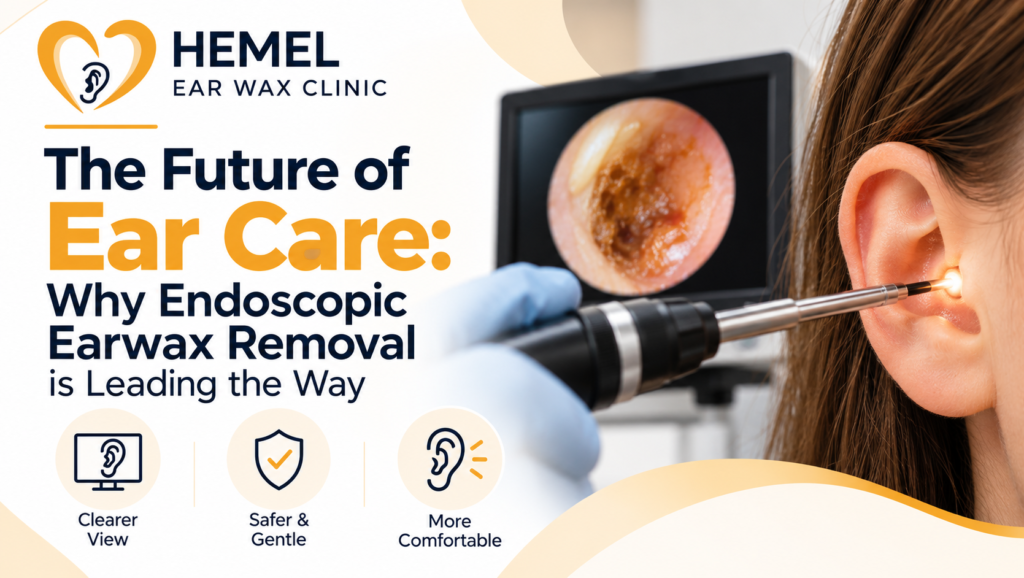
Endoscopic earwax removal combines modern visual technology with professional wax-removal techniques, helping clinicians see the ear canal clearly throughout treatment.
Earwax removal has changed significantly from the days when water syringing was the main option available to many patients.
Today, clinicians can use improved visual technology to examine the ear while they work. Endoscopic earwax removal is one example. Instead of relying on a limited view, an endoscope provides bright, magnified visualisation of the ear canal.
Hemel Earwax Clinic already offers this modern approach in Hemel Hempstead and may combine endoscopic visualisation with suction or specialist instruments where appropriate.
Importantly, however, no single earwax-removal method suits every ear. NICE recognises microsuction, electronic irrigation and professional manual removal when trained practitioners use suitable equipment.
Key Takeaways
- Endoscopic earwax removal gives clinicians a magnified, illuminated view.
- The clinician can see the wax throughout treatment.
- Endoscopic viewing may help with narrow or curved ear canals.
- Clinicians can combine visualisation with suction or micro-instruments.
- The method does not rely on blind manual syringing.
- No earwax-removal method is universally best for every patient.
- Hemel Earwax Clinic provides endoscopic earwax removal in Hemel Hempstead.
What Is Endoscopic Earwax Removal?
Endoscopic earwax removal uses a slim medical camera to visualise the ear canal during treatment.
The endoscope provides an enlarged, illuminated image. Therefore, the clinician can identify the position of the wax, bends in the canal and surrounding structures before and during removal.
At Hemel Earwax Clinic, clinicians may then use gentle suction or specialist micro-instruments while maintaining a clear view of the treatment area.
“Modern ear care is increasingly about seeing clearly before acting, rather than treating a blocked ear by guesswork.”
Why Is Better Visualisation Important?
Better visualisation helps the practitioner see exactly where the wax sits and how the ear canal looks.
Ear canals vary significantly between people. For example, some are narrow or curved, while others contain hard wax that sits close to sensitive canal skin.
Consequently, a clear view can help the clinician plan each movement carefully.
Direct vision already plays an important role in professional microsuction. University College London Hospitals explains that clinicians remove wax under direct vision to help avoid trauma.
Endoscopic technology applies the same principle while providing a digital, illuminated view.
How Is Endoscopic Earwax Removal Different From Microsuction?
Endoscopy describes how the clinician sees the ear; microsuction describes one method used to remove the wax.
Therefore, the two techniques can work together.
Technique | Main Purpose |
Endoscope | Provides an illuminated view of the ear canal |
Microsuction | Removes wax with controlled suction |
Manual instruments | Remove suitable pieces of wax under visual guidance |
Electronic irrigation | Uses controlled water flow to remove wax |
Hemel Earwax Clinic states that it may combine endoscopic visualisation with suction for greater control during treatment.
However, NICE does not identify endoscopy as a separate wax-removal method. Instead, it recognises microsuction, electronic irrigation and professional manual removal.
Why Is Endoscopic Earwax Removal Considered a Modern Approach?
Its main advantage is enhanced visual access during the procedure.
An endoscope can help clinicians inspect bends and narrow sections of the canal. Additionally, digital viewing can make it easier to assess where wax remains before finishing treatment.
Hemel Earwax Clinic highlights direct visualisation, precision and the ability to use endoscopic viewing alongside suction or micro-tools.
Still, “modern” does not automatically mean “best for everyone”. The safest method depends on the patient’s ear anatomy, medical history and wax.
NICE notes that evidence comparing different earwax-removal methods remains limited.
Who May Benefit From Endoscopic Earwax Removal?
Endoscopic viewing may be particularly useful when visibility inside the ear canal matters.
For example, it may help when a person has a narrow or curved canal, difficult-to-position wax or previous uncomfortable treatment experiences.
Additionally, people who use hearing aids can develop troublesome wax more frequently. NICE notes that excessive wax is particularly common among hearing-aid and earbud users.
However, the clinician should always examine the ear and decide whether removal is appropriate before treatment begins.
What Happens During an Endoscopic Earwax Appointment?
The appointment starts with assessment rather than immediate removal.
At Hemel Earwax Clinic, the clinician reviews your symptoms and relevant history first. Next, they examine the ear and explain the proposed procedure.
If endoscopic removal suits your ear, the clinician can then use the camera to visualise the canal while removing the wax with suction or appropriate micro-instruments. Finally, they check the ear again and provide aftercare advice.
The clinic’s wider consultation process also includes otoscopic examination, explanation of treatment, consent and aftercare.
Is Endoscopic Earwax Removal Comfortable?
Many patients tolerate professional endoscopic removal well, although individual experiences vary.
You may hear suction noise or notice mild pressure during treatment. Therefore, tell the clinician immediately if you feel uncomfortable or dizzy.
Professional earwax removal should never become a test of endurance. The clinician can pause treatment when necessary.
“Precision matters, but patient comfort matters too—the best treatment combines clear visualisation with careful communication.”
Endoscopic Removal vs Traditional Syringing
The main difference is that endoscopic treatment allows continuous visualisation, while traditional manual syringing does not provide the same direct view.
NICE advises healthcare professionals not to offer manual syringing for adult earwax removal. Instead, NICE recommends considering electronic irrigation, microsuction or professional manual removal when appropriately trained practitioners provide the service.
Therefore, patients should distinguish old-style manual syringing from modern electronic irrigation.
Can You Prepare Before Treatment?
Softening very hard wax may sometimes make treatment easier.
Hemel Earwax Clinic recommends olive ear spray for around five days before treatment where suitable. The clinic explains that this can soften wax and make removal more comfortable and efficient.
However, drops do not suit every ear. Ask for professional advice if you have ear discharge, previous surgery, a perforated eardrum or another significant ear condition.
How Is Hemel Earwax Clinic Using Modern Ear Care?
Hemel Earwax Clinic combines visual assessment with professional wax-removal technology.
Its existing guide to endoscopic earwax removal explains that clinicians use endoscopic visualisation alongside suction or micro-instruments where appropriate.
The clinic is located at 49A St John’s Road, Boxmoor, Hemel Hempstead and also offers an at-home earwax service.
You can read the clinic’s Endoscopic Earwax Removal guide or review its Consultation Process before booking.
Common Misconceptions
“Endoscopic removal is completely different from microsuction.”
Not necessarily. Endoscopy provides visualisation, while microsuction may provide the actual wax-removal mechanism.
“The newest method must always be the best.”
No. The right method depends on the person’s ear and clinical assessment.
“Earwax should always be removed.”
No. Earwax normally protects the ear and only needs removal when it causes problems or prevents examination.
“Cotton buds are an alternative.”
No. NICE warns that cotton buds can push wax deeper and damage the ear canal or eardrum.
People Also Ask
What is endoscopic earwax removal?
It uses a small illuminated camera to help the clinician see inside the ear canal while removing wax.
Is endoscopic earwax removal the same as microsuction?
No. Endoscopy provides the view, while microsuction uses controlled suction to remove wax. However, clinicians can combine them.
Is endoscopic earwax removal safe?
It can be suitable when an appropriately trained practitioner performs it after assessing the ear.
Does endoscopic earwax removal use water?
Not when the clinician combines the endoscope with suction or manual instruments.
Where can I get endoscopic earwax removal in Hemel Hempstead?
Hemel Earwax Clinic offers endoscopic earwax removal in Boxmoor.
Conclusion
Endoscopic earwax removal represents an important development in modern ear care because it gives clinicians a clear, illuminated view throughout treatment.
Additionally, clinicians can combine that visualisation with microsuction or specialist instruments according to the individual ear.
However, technology alone does not determine good ear care. Careful assessment, trained practitioners and the right treatment for each patient remain essential.
Hemel Earwax Clinic provides endoscopic earwax removal in Hemel Hempstead for patients seeking modern, assessment-led ear care.
Medical notice: This article provides general ear-health information and does not replace individual clinical or medical assessment.
FAQs
Can endoscopy show narrow parts of the ear canal?
Yes. The illuminated camera can help clinicians inspect difficult areas.
Can hard wax be removed endoscopically?
Often, although particularly hard wax may benefit from softening first.
Does treatment hurt?
Many patients tolerate it well, but discomfort can occur and treatment can pause when necessary.
How long does an appointment take?
Hemel Earwax Clinic’s endoscopic guide says appointments typically take around 20–30 minutes, including assessment and aftercare.
Can hearing improve after wax removal?
Yes, when impacted wax was responsible for the reduced hearing.
Is endoscopic removal suitable for every patient?
No. A clinician should assess each ear individually.
Can clinicians use instruments as well as suction?
Yes. Appropriate micro-instruments may complement suction under visual guidance.
Should I use cotton buds beforehand?
No. They can push wax further down the canal.
